Rental duration
One day / Weekend / Three days
Useful for planning time, but it does not tell a renter which equipment belongs together.
8bit Rental / Equipment rental experience
Filmmakers arrive with a shoot in mind. Their rental experience should start there, too.
I designed a kit-first booking experience that brings equipment choices, rental dates, and reservation review into one connected journey.
Start with
the shoot.
Then the gear.
01 / The business problem
An interview shoot needs a working setup, not just a camera.
In the existing journey, renters had to browse individual items, compare specifications, assemble a setup, and work out dates and pickup. That places the burden of coordination on the person trying to plan a production.
For indie filmmakers, students, small crews, and content creators, those decisions sit alongside tight budgets and production schedules. The design opportunity was to make a suitable starting point easier to find, while keeping room for more specific equipment choices.
Company context during my work at 8bit Rental; platform scale, rather than acquisition attributed to this redesign.
The insight that shaped the work
“What am I shooting?”
comes before
“Which gear do I need?”
This framing emerged from team discussions and the field observations documented in my project deck. It became the organizing principle for the booking experience.
02 / A product decision
I compared three ways to help renters find a starting point. Each made a different part of the decision easier.
The tradeoff: a kit cannot anticipate every production. I kept category browsing and equipment swaps available so the shortcut would not become a constraint.
A change in the sequence of decisions
Browse gear → Compare specs → Build a setup → Work out dates
Choose a shoot → Review a kit → Adjust equipment → Select dates → Reserve
03 / The designed experience
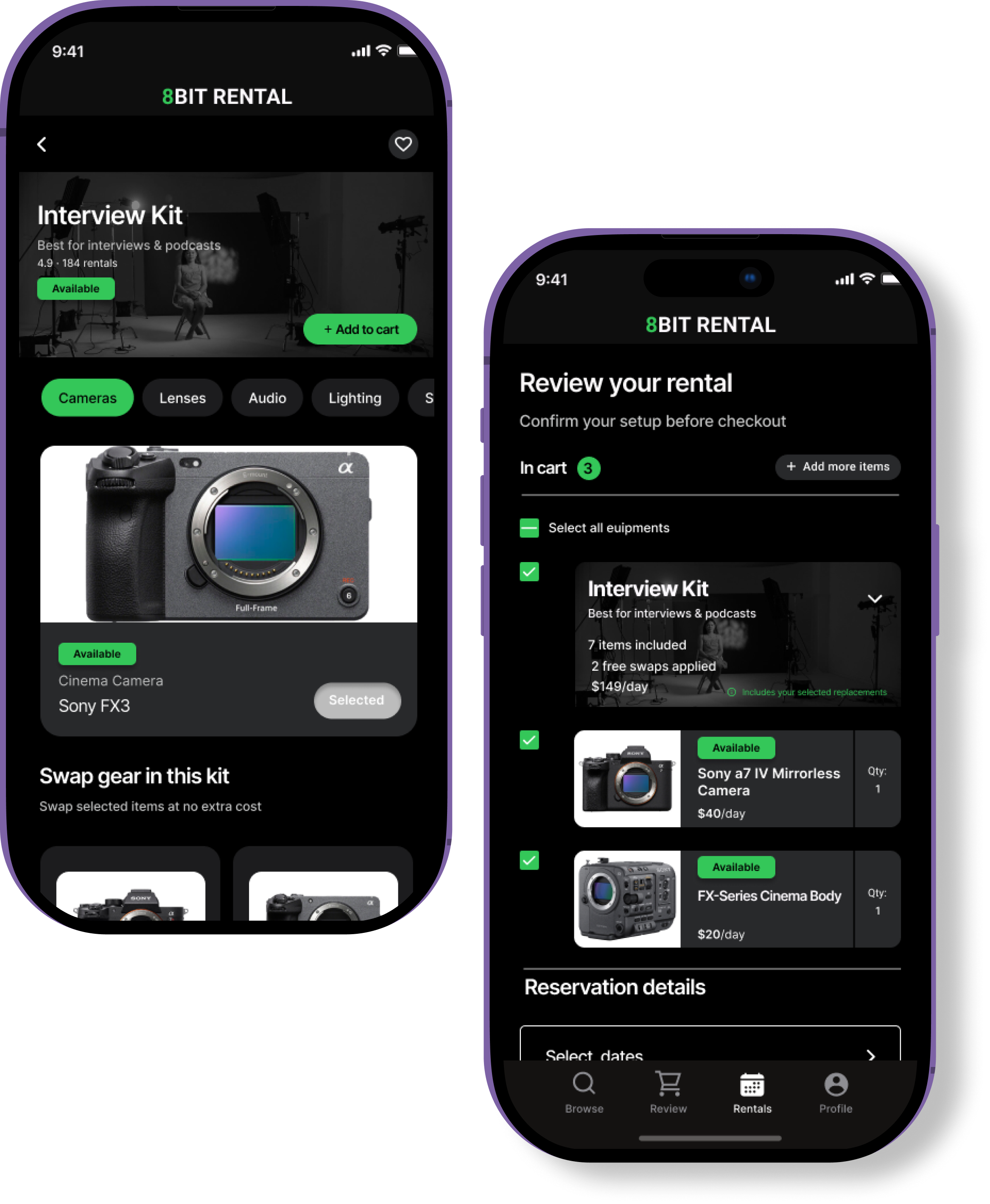
The home screen asks “What are you shooting today?” and introduces kits around production needs. An Interview Kit makes the purpose legible before the user has to evaluate individual specifications.
Search and category browsing remain available for renters who already know what they want.
Design intent / Make the first choice feel manageable.
The kit detail screen brings the included equipment into view. Categories such as camera, lenses, audio, and lighting help renters understand the setup without losing the context of the kit.
Equipment swaps preserve flexibility: the suggested setup supports a decision without making every decision for the renter.
Design intent / Balance guidance with control.
Reservation review gathers the selected kit, additional equipment, and rental details into one place. Date selection is part of the same flow, followed by a reservation state users can return to.
The aim is to make the commitment explicit: what is being rented, and when.
Design intent / Keep logistics connected to the equipment decision.
04 / Outcomes & delivery
The project materials record improvements in booking time and repeat bookings. They are presented separately from the unlaunched design shown above.
25%less time
8 min 40 sec → 6 min 30 sec
Reported in the project deck. Measurement method and sample size are not documented in this case study.
30%repeat booking rate
18% → 30% · an increase of 12 percentage points
Reported in the project deck. The observation window and cohort definition are not documented here.
These figures provide project context; they do not establish that this unlaunched prototype caused the changes.
I was responsible for the UX and UI design during my work at 8bit Rental and delivered the designs and interactive booking prototype to the project lead.
Looking ahead
The same idea extends beyond equipment kits. My additional concepts explored guided robotics studio sessions and equipment demonstrations as ways to understand an unfamiliar tool before reserving it.
For the core booking flow, a next validation step would be to compare kit-based and individual-item tasks with the same shoot brief, tracking completion time, equipment errors, and confidence. That would help separate the value of the design from broader business changes.